
Your Mind Is Your Home
Dream, Darling by Laila

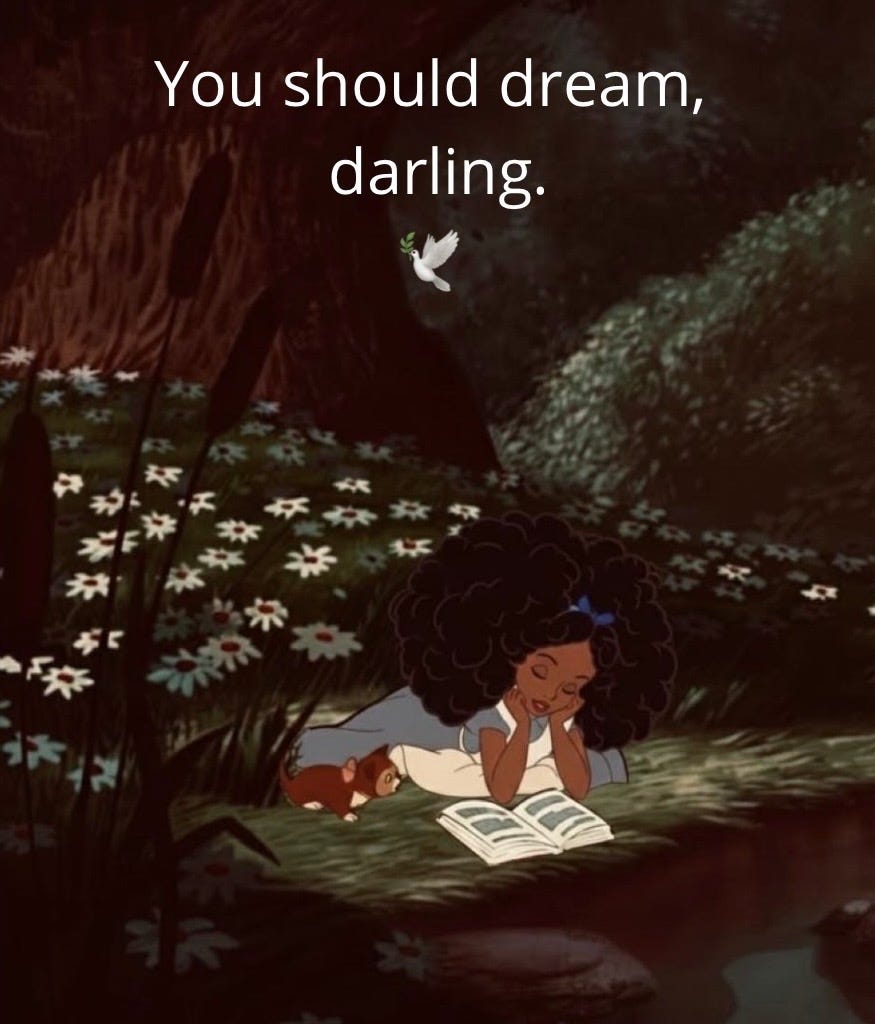
Since childhood, I have been known for my smile. It was unusual for anyone to see me without one. In fact, my classmates in middle school gave me the nickname Smiley.
You would often find me sitting in the corner of a room, staring out the window, daydreaming. I would make up scenarios about what my life would be like: me in a corner office at a big company, traveling the world, or meeting the love of my life.
I couldn’t wait to grow up. I was convinced it was going to be like 13 Going on 30.
Well, I’m almost thirty years old, which is still a wild concept to me. Life hasn’t exactly turned out the way I dreamed it would. Yet, I never lost hope. However, this year has been different. It has become one of the hardest years of my life.
I began losing hope.
I lost my scholarship.
I had to move back home.
I’ve never been close with my family.
Coming back to Denmark after living in London, England, was already humbling and embarrassing. I truly believed I was going to graduate with my master’s degree and continue living in England. But that wasn’t what was planned for me.
Instead of returning to a compassionate family, I was met with ridicule and mockery.
One family member told me, “Why do you keep trying? Why don’t you just give up and move to a small town? It’s not like we’re going to visit you there anyway.”
Another family member told me, “I never want my kids to end up like you,” essentially implying that I was a failure.
Safe to say, I began losing my confidence and my excitement to keep trying.
I’m not writing this to trauma dump on you. I want to explain the mental prison I’ve been trapped in—the one that led me to stop daydreaming and believing in myself.
I let the opinions of people who don’t truly know me become the loudest voices in my mind.
Which is a dangerous place to be in, especially as someone who has always believed in the energy you are in, is the energy you attract.
“Indeed, Allah will not change the condition of a people until they change what is within themselves.” (Qur’an 13:11)
This is a verse with many layers of meaning, but for me, it speaks to the relationship between our internal state and our external reality.
I don’t believe that we are the sole creators of our lives. God is the One who is in control. But I do believe that we have a responsibility for what we cultivate within ourselves. If we choose to remain in a hopeless, negative mindset, it becomes much harder to recognise opportunities, take action, and trust in God’s plan.
Changing what is within ourselves doesn’t guarantee a particular outcome, but it does change the way we move through life. And perhaps that’s where transformation begins.
That verse has made me think a lot about what I allow to live in my mind.
The mind is fertile ground. Whatever you water will eventually grow.
For months, I watered fear. I replayed every hurtful comment that had been said to me until those words became louder than my own. I started seeing myself through the eyes of people who had already decided who I was.
Whether you call it your inner dialogue, your self-concept, or your assumptions, what you repeatedly believe about yourself begins to shape the way you move through the world.
One lesson I’ve taken from teachers like Neville Goddard and Abraham Hicks is the importance of guarding your inner world. They both speak about not allowing your external circumstances to dictate your internal state. Instead, they encourage you to become anchored in the version of yourself you’re growing into, rather than the person your current circumstances seem to describe.
Whether you agree with every aspect of their philosophy or not, I think there is wisdom in refusing to let outside noise become your identity.
For me, that doesn’t replace my faith—it brings me back to it.
The Qur’an reminds us that Allah will not change the condition of a people until they change what is within themselves. To me, that starts with protecting my mind. Being intentional about what I consume, whose opinions I give authority to, and which thoughts I allow to take root.
Not every voice deserves a seat at your table.
Sometimes the loudest voice in your life should be your own—and the One who created you.
Over the past few months, I’ve become intentional about what I feed my mind.
Every night, I fall asleep listening to Louise Hay’s affirmations. During the day, I meditate while listening to Neville Goddard, Abraham Hicks, and other teachers who encourage you to become aware of your inner dialogue.
Whether it’s psychology, neuroplasticity, or simply the power of repetition, I know one thing for certain: the voice in my head has started to change.
It didn’t happen overnight.
At first, repeating kind words about myself felt unnatural. Almost like I was lying to myself. But slowly, the harsh inner critic that had been echoing my family’s opinions began to lose its grip.
I’ve noticed myself standing a little taller.
Speaking a little kinder to myself.
Believing, even if only for a moment, that maybe my life isn’t over, that maybe this chapter isn’t my ending.
For months, I carried negativity like it was my identity. I expected disappointment because disappointment had become familiar.
But lately, I’ve grown tired of living that way.
I’m tired of assuming the worst.
I’m tired of seeing every closed door as proof that I’ll never make it.
I want to become someone who expects good things, not because life owes me anything, but because I refuse to let fear be the author of my story anymore.
Optimism is a practice.
Confidence isn’t something you wake up with one day.
It’s something you build, thought by thought, prayer by prayer, and choice by choice.
And for the first time in a long time, I feel like I’m building it again.
One teaching from Neville Goddard that has stayed with me is the idea of feeling the state of the wish fulfilled.
The premise is simple: instead of constantly reminding yourself of what you lack, you spend time embodying the version of yourself who already believes that what they’re praying and working towards is possible.
For me, it isn’t about pretending my problems don’t exist.
It’s about refusing to let my current circumstances become my identity.
If I want to become a confident woman, then I have to start thinking, speaking, and carrying myself like confidence is already growing within me.
If I want to build a meaningful career, then I have to stop introducing myself as someone who has failed and start acting like someone whose story is still unfolding.
If I want to find peace, then I can’t spend every waking moment rehearsing worst-case scenarios.
I’ve realized that my mind doesn’t always know the difference between a memory, a fear, or a possibility. The stories I tell myself become the lens through which I see everything.
So instead of rehearsing rejection, I’ve started rehearsing hope.
Instead of imagining everything falling apart, I’ve started imagining what it would feel like if God opened the doors I’ve been praying for.
What would I sound like?
How would I carry myself?
How would I treat other people?
How would I wake up in the morning?
The more I sit with those questions, the more I notice that the person I’m trying to become isn’t waiting for a future version of my life. She begins with the choices I make today.
I still make du’a(prayer). I still put my trust in God. I still accept that His plans are greater than mine. But I’ve stopped letting fear be the loudest voice in the room.
If you’ve made it this far, maybe some part of my story feels familiar.
Maybe you’ve allowed other people’s opinions to become your own.
Maybe you’ve stopped dreaming because disappointment has convinced you that it’s safer not to.
Or maybe you’re simply exhausted.
If that’s you, here are a few things that have helped me find my way back to myself.
Protect your mind like you protect your home.
Not everyone deserves access to your inner world. Be intentional about what you consume, who you listen to, and whose opinions you carry. Every thought you entertain is planting a seed.
Become aware of your inner dialogue.
Pay attention to the way you speak to yourself. Would you speak to someone you love the way you speak to yourself? If the answer is no, it’s time to rewrite the script.
Give yourself permission to dream again.
Dreaming isn’t childish. It’s often the first step towards creating a different future. Allow yourself to imagine a life beyond your current circumstances.
Spend time with the version of yourself you’re becoming.
Journal as that version of yourself. Pray as them. Make decisions as them. Ask yourself, What would the person I’m becoming choose today? Then do that.
Detach from the timeline.
You don’t have to know when everything will happen. Your job isn’t to control the timing—it’s to keep showing up.
Protect your hope.
Not everyone needs to know your dreams. Some people will project their limitations onto your life. Learn to distinguish between constructive advice and someone else’s fear.
Pray, then move your feet.
Faith isn’t passive. Make the prayer. Send the application. Start the business. Apply for the scholarship. Publish the article. Let your actions become evidence of your trust in God or what it is you believe in.
Remember that this chapter isn’t the whole story.
One difficult year doesn’t define your entire life. One rejection doesn’t determine your destiny. You’re allowed to begin again as many times as it takes.
If there’s one thing I hope you take away from my story, it’s this:
Don’t let the people who have the smallest vision for your life become the narrators of it.
Guard your mind.
Protect your hope.
And never stop believing that God can write a story greater than the one you’ve imagined for yourself.
With Love,
Laila🫶🏾🕊️
Not one lie was told I love how you always speak so beautifully about god it’s truly inspiring 🥺🥺 I’m so proud of the woman you’re becoming ❤️❤️
Ameen and Asè