
Copenhagen Blue Notes
By Laila Abdelle

Like many of you know, I’ve been writing this book. It has been a passion project for me for the past two years. However, when I began querying literary agents it did not lead to much. If I am being honest, when I started querying I kinda knew it was not ready but I was growing frustrated with the time it was taking me. After all, two years is a long time at least for me and I have never been a very patient person… Nevertheless, the rejections forced me to take a step back and look at my work with fresh eyes.
Like I suspected it was not ready and it lacked something — do not get me wrong I still believe it’s good and the story has potential. But it needed a rebrand….
I began brainstorming in ways to better it, so I reached out to a friend of mine. Someone who was already in the field, I wanted his opinion on what I could do better? What is it that I could not see?
He finally set up a meeting with me.
I’ve always been someone who dealt with imposter syndrome, so leading up to this meeting was filled with anxiety as if he was going to scold me for it to be bad. Thankfully, he did not hahaha I am still learning that I am safe.
In that meeting he told me the book had potential, how to structure a novel and that I need to work on my description better — that I should trust readers more, which was helpful, however he proposed an idea to move the story location to Denmark (Where I am from) since I knew what live here was like.
A small note, in case I have never mentioned it before, the book I am writing is a literary romance about two young Black artists. Who unexpectedly find connection through art, poverty and emotional vulnerability. Set against the backdrop of New York City. Because for me, when I think Black love especially Black artistic love I think New York City.
So when he proposed that idea, my initial reaction was to dismiss it, because he does not know what life in Denmark is for a non-western Danish person (even describing myself as Danish is wild hahah). I should mention that he is from England. I knew his experience as Black in England was a bit different, how much I do not know but from what I have seen and experienced in my many years of being a frequent visitor to England. That there was a voice of expression allowed for people from different backgrounds to express themselves. This is not to say that the voice is loud, but it's visible. In Denmark, however, there is a silence needed for survival to exist. Meaning the history of Nordic countries forcing or requiring non-western immigrants or descendents to strip themselves of their roots in order to be accepted or at least more palatable for Nordic societies.
Which is why my initial reaction was I do not know if a story like this can exist in Denmark? His response was why don’t you try to find out?
Low and behold, you guys…. It can!
I was deeply surprised in my discovery, that not only is there creatively relevant, but the context in which this story can exist in the backdrop of a Nordic country such as Denmark might even be revolutionary for the book but hopeful when rewritten can become a microscope for Black art in Denmark.
Through my research, I found many racial nuances in which I already kind of knew - or at least not surprised by. My research aims to examine how Black creatives in Denmark negotiate identity, belonging, and artistic visibility within Scandinavian Cultural spaces.
There was an article I found by Stine Nørregade Lykkebo, refleksion over hvidhed i dansk kunstliv. Translated to Reflection on whiteness in Danish art life.
In this article, the writer reveals a study that only 12 percent of art exhibits and installations feature non-western artists.
A quote in the article by an Arabic Danish painter, Dina El Kaisy
“Det hele er et større system, som bunder i racisme, ikke i dovenskab eller manglende ressourcer, som de hvide institutioner elsker at undskylde med. Hvide kunstinstitutioner i DK har ikke interesse for det, jeg gøre of sige”
Translated to
“It is all a large system, which is rooted in racism, not in laziness or lack of resources that white institutions love to use as an excuse. The white art institutions in DK have no interest in what I do or say.”
Upon research, it shows that in order to drive in Denmark as a non-Western artist you have to compromise with your morals and values. There seems to be an unspoken rule almost in order to feature in one of these institutions in Denmark as a non- Western your work has to be centred around colonial or diaspora trauma. As if there cannot be any mention of other aspects of being non-Western and if you are muslim it seems that their is an expectation on having certain erotica in muslim art in Denmark or a dismissal of Islamic religion.
This discovery reminded me of Bell Hooks art on my mind book, there is a passage in which she wrote.
“It occurred to me then that if one could make a people lose touch with their capacity, to create, lose sight of their will and their power to make art then the work of subjugation of colonisation is complete. Such work can be undone only by acts of concrete reclamation”.
What does it say that in the country I was born and raised, are deliberately leaving out voices across diasporas or control the narrative in which our voices are shared?
In a book, I`ve been reading. Titled Afro Nordic landscape by Michael McEachrane aims to expose racial findings in Nordic society, as well as identifying race identity, and belonging across the Nordic region — including Denmark of course. It was in this book, the history of art in Denmark connected to my story.
The author argues that in today’s world, culture is increasingly seen as the main cause of conflict between societies. According to Michael McEachrane, many people believe we are living in a time of ‘inter-civilisational war’, where different civilisations, especially the west and non-western societies, are viewed to be fundamentally incompatible. He, therefore, believes the idea presents culture as something fixed and impossible to change, making reconciliation between groups seem impossible.
The book suggests that cultural divisions are often connected to religion and are frequently linked to physical appearance such as skin colour and phenotype. According to the author, even though people may speak of ‘culture’ rather than race, these ideas still often reinforce racial divisions and the belief that certain groups do not belong in western civilisations.
He goes on to describe how Nordic Europeans traditionally understand their national identity to be connected to whiteness. The author explains how ideas such as citizenship, equality and democracy in liberal western societies were historically built around whiteness and often excluded non-white people from fully belonging.
There is a widespread self-conception of the Nordic countries that they were mere bystanders to European colonialism and slavery, therefore are largely unscathed by racial worldviews.
“The truth is that Nordic countries are not without colonial history nor have they been untouched by racial worldviews” - a quote from the book.
Denmark, itself had colonised three Caribbean islands until they sold to the US and was the seventh largest slave trading nation during colonial time.
The Nordic Countries have historically made white Europeans the picture of virtue, civilisations, history, beauty, human rights and the identity of nation.
A tradition which is still very prevalent in Danish society, seen in politics, films and every-day discussions. As a Black Somali descendant, I have been affected many times by this notion of whiteness being superior in Denmark.
The question then becomes how do I connect all of the racial tones found in Denmark society into a Black love story centred around art?
This book has become sort of a safe haven for my research, because in it it tracks back to the origin of Jazz being Black American. Of course, it always was, but I am trying to say that Danish Jazz was in its origin personally Black American created.
During the rise of Jazz it is safe to say that the Nordic countries did not get it, of course reporting it with more racial discrimination. During Louis Armstrong touring Europe, he was described as ‘cannibal offspring’, ‘a gorilla from the jungle’ and his trumpet being described as ‘ a tiger roaring’ absolutely disgusting I know.
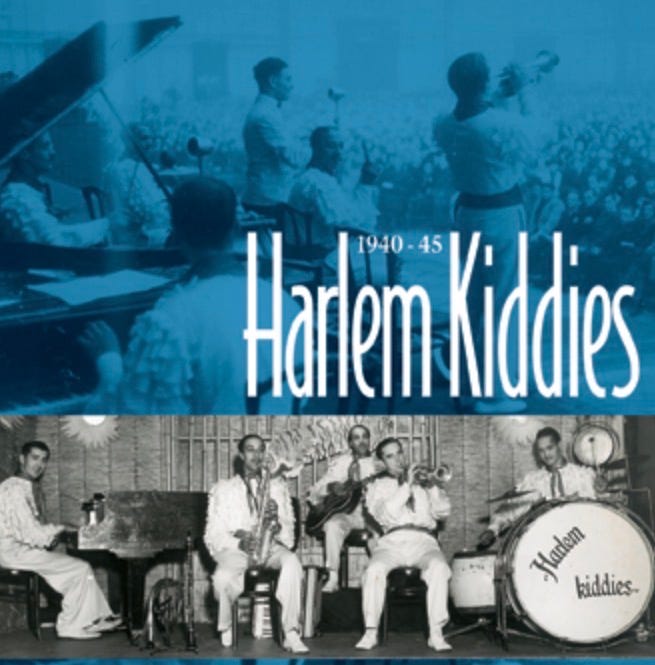
However less than a decade later Jazz became the most sought out music genre in Denmark. During world war 2, the Harlem kiddies gained extreme popularity during the occupation. In an interview with Anna Dvinge a Danish entrepreneur who has a ph.d. in American Jazz studies as a musicologist. This interview is found in the book, Dvinge argues their popularity was due to symbolising resistance towards the presence of Nazi ruling in DK.
Harlem Kiddies was seen as anti-German, becoming one of the most influential Jazz groups in Denmark during the 1940s.
The band consisted of two Jewish singers and three mixed raced black musicians, which in the 1940s was a wild statement to make. But nevertheless the Harlem Kiddies existed and were thriving in Denmark.
The book quotes many Black American artists who relocated their lives to Scandinavia in the 1960s.
Jazz saxophonist Albert Alger who lived in Sweden said on Danish radio “Scandinavia makes me feel free”. In an NAACP article, published an article in 1961 an article title ‘A Negro Reports from Denmark’ by the journalist Leonard Marlon wrote “Perhaps for the first time in his life, the Negro has breathing space”.
Copenhagen became among some of the Nordic cities as a safe haven and alternative to Paris as an escape from America.
According to Michael McEachrane during the height of Jazz. Copenhagen became a global capitol beside New York — Even gaining the nickname amongst Black American artists as the Cop.
It is important to mention an historic Jazz club located in Copenhagen named Jazzhus Montmarte. It has been a cornerstone of European Jazz culture , being a vital role in shaping the Scandinavian Jazz scene and remains an important venue for live performance today.
Here is a list of Black American Jazz players who remained in Denmark
Jazz players who remained in dk
Dexter Gordon and Yusef Lateef—but who also passed away
there: Oscar Pettiford, Ben Webster, Aubrey Milton Moore, Thad Jones, Kenny Drew, Ernest Wilkins, Duke Jordan, Ed Thigpen.
Even some streets in Copenhagen are named
after Black American jazz greats: Kenny Drews Vej, Ernie Wilkins Vej
and Thad Jones Vej.
Due to the ruling Danish Musicians had to be present in the band during performances in Denmark. Allowed Danish musicians to learn from famous Jazz players shaping Danish Jazz. Jazz became accepted as part of Danish identity itself..
The question now becomes how do these findings, especially the origin of Jazz in Denmark influence my story. Because it allows there to be a larger narrative in my romance story, including the importance of visibility, the fact I could not see this story in this country to begin with. Is why it is so important, that the voices of those silence be heard, it’s bittersweet knowing that Denmark once was a safe haven for Black artists and now disregards those parts of its story. I think it is important for voices to be heard and faces to be seen, this story belongs here. Nationalism, patriotism be damn I to am a part of the Danish story, and so are these wonderful Black Americans who were incredible brave to venture out of a scary place to an unknown place and make it a historic landmark even if the story is being deliberately forgotten, now that I know I won’t forget.
This is why my romance book belongs here, and is now regarded as a homage to Black artists who paved the way. I may not be Black American, but I am a Black Scandinavian even If that term does not exist yet.
With Love,
Laila 🤎
Omg babe the depth of knowledge you’re bringing into this topic is super amazing to see I love how you made a point that this history will not be forgotten. I’m so proud of all your hard work and I honestly cannot wait to read the full book combined with all these fascinating details you’ve taught me today, just truly incredible honestly.❤️❤️❤️